Feb 4, 2026
The end of the “vibe check”: Introducing Test-Driven Context Engineering

From vibe checks to verifiable AI
"Is it better?"
"I think so... the vibes feel right."
For many teams, this is the current state of AI quality assurance: you launch an update, then rely on a patchwork of transcript sampling and gut-check reviews to see whether the agent is behaving as intended. But as agents move to the center of customer-facing applications, this reactive, subjective approach isn’t just inefficient—it is a business risk.
This article introduces Test-Driven Context Engineering (TDCE) as a rigorous solution to this volatility. By adapting the battle-tested principles of Test-Driven Development (TDD) to the probabilistic world of AI, TDCE replaces "vibe checks" with automated simulation, AI-powered diagnostics, and continuous refinement. This methodology enables organizations to deliver production-ready AI systems faster and with the measurable validation required for the enterprise.
The evolution of evals: from snapshots to storylines
To build a production-ready AI, we must move beyond measuring individual responses and start measuring the entire user journey. This requires an evolution from Single-Turn Evals to Multi-Turn Evals.
1. Single-turn evals: the "snapshot"Most industry-standard evaluation tools assess only a "snapshot" within a conversation. They use a "Given X, Assert Y" model to look at one completion in isolation (e.g. given user message X, is response Y adequately similar to a golden dataset answer). They are blind to the "narrative" of the interaction. A single-turn eval can confirm an answer is factual or polite, but it cannot tell you if the AI is repeating itself, successfully steering a user through a prequalification flow, or if it actually solved the user's problem by the end of the call. They cannot capture the behavioral trajectory of a conversation.
2. Multi-turn evals: the "storyline"Multi-turn evals shift the focus from the output to the outcome. Instead of analyzing a single string of text, these evals ingest the entire conversation transcript as a single unit of work. This shift allows for Behavioral Auditing—checking if the AI actually followed the intended business process. They enable teams to answer complex business questions that a snapshot cannot:
Goal Completion: Did the agent eventually collect the user’s email address?
Resilience: Did the agent maintain its persona even after the user became frustrated?
Steering: Did the agent successfully bring the user back to the primary goal after a tangent?
The missing piece: where does the data come from?
While multi-turn evals are objectively more powerful, they present a major engineering hurdle: they require a full conversation to analyze. If you only have single-turn evals, you can test your prompt in milliseconds. To run a multi-turn eval, you traditionally need a human to sit down and roleplay a 10-minute conversation with the bot just to generate one test case. This manual bottleneck is what keeps most teams stuck in the "Snapshot" phase. Consequently, developers rely on manual "vibe checks" or roleplaying to evaluate how an agent handles multi-turn context, steering, and state. To scale this, we need a way to generate these "storylines" automatically.
If the Multi-Turn Eval is the "Black Box Recorder" that judges a flight, the Simulation Testing Engine is the flight simulator itself. It solves the manual bottleneck of roleplaying by creating a synthetic environment where AI behavior is validated against business requirements at scale.
The engine operates by orchestrating a high-speed dialogue between two distinct agents:
The Simulated User: A synthetic persona programmed with specific goals, temperaments, and knowledge (e.g., "A skeptical prospect who is worried about pricing, and works at a company with 500 employees.")
The Production Chatbot: Your actual AI system, running with the current prompt and context configuration.
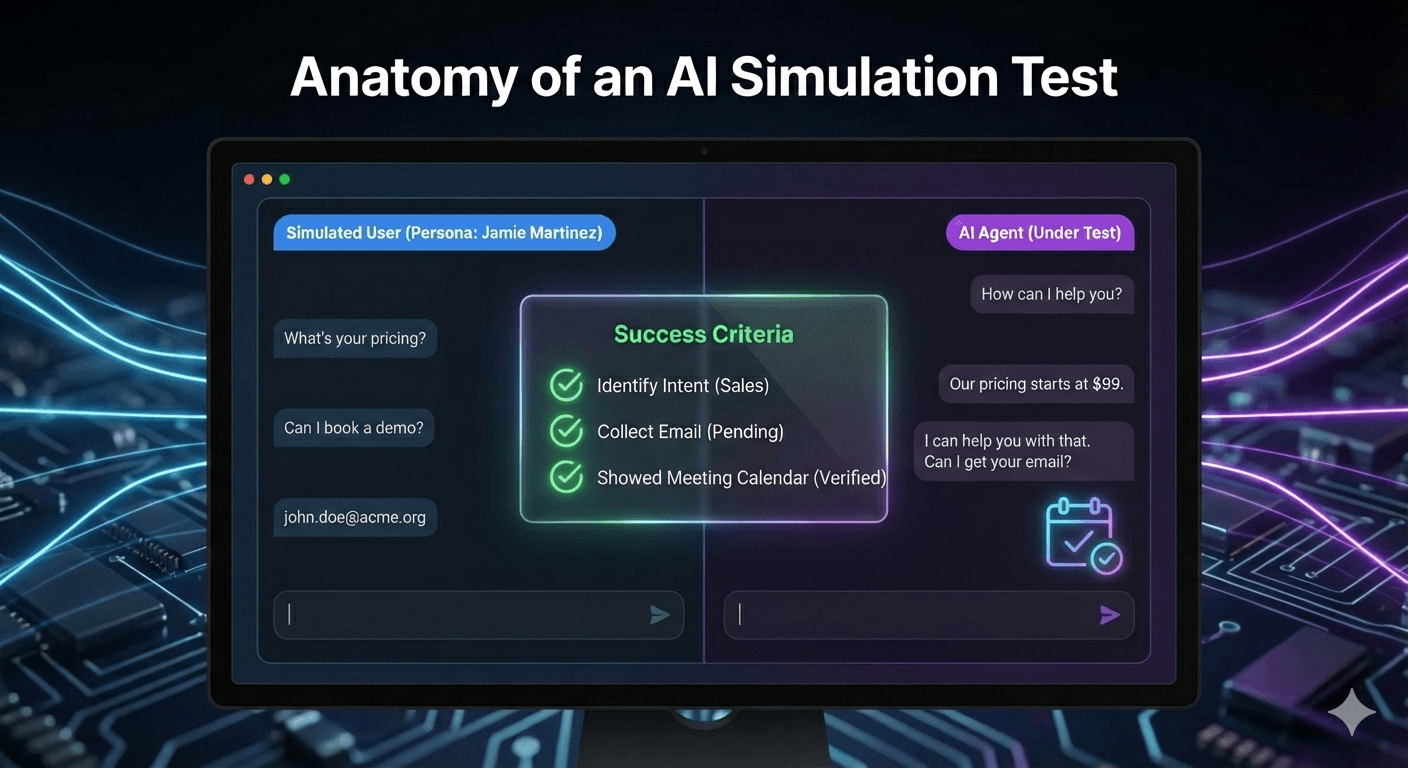
By alternating messages between these two agents, the engine generates a complete, multi-turn transcript in seconds. This isn't just a "test script"; it is a dynamic interaction where the simulated user reacts in real-time to the chatbot’s responses. If the chatbot gives a confusing answer, the simulated user becomes confused. If the chatbot is persuasive, the simulated user moves toward the goal.
Solving the "Dynamic Path" ProblemTraditional software testing relies on Deterministic Assertions: Given input X, assert output Y. However, conversational AI is probabilistic and dynamic. The same initial greeting could lead to a dozen different, equally valid conversational paths depending on how the user responds. You cannot test this "state space" with a spreadsheet of inputs and outputs. You must test it with Simulated Behavior. The engine allows you to verify that no matter which path the conversation takes, the AI remains within the guardrails and achieves the intended business outcome.
The AI Copilot: from diagnostic insight to actionable fix
If the simulation engine is the laboratory and simulation the experiment, then the AI Copilot, what Spara has named ‘Ask AI’, is the resident expert. When a simulation fails, and the evaluation reports the failure assessment, the Copilot performs root cause analysis. It doesn’t just look at the final transcript; it analyzes the "Behavioral Trajectory" against the underlying system configuration. It asks the hard questions:
Knowledge Gaps: Did the bot fail because the necessary information was missing from the context window?
Instructional Conflict: Did a specific brand guideline clash with a task-oriented instruction, causing the bot to freeze or hallucinate?
Reasoning Breakdowns: Did the model simply fail to follow a logical chain of thought despite having the right information?
By pinpointing exactly where the conversation went off the rails, the Copilot turns a "red light" into a specific, technical diagnosis. Once a hypothesis of the root cause is identified, the Copilot moves from analysis to action. The Copilot can immediately generate potential remedies. This is where the process becomes a flexible choice between speed and steering:
Parallel Automation: The Copilot can generate multiple potential fixes in parallel. It spins up new simulations for each version to see which candidate "survives" the evaluation suite—effectively automating the trial-and-error process.
Human-in-the-Loop Collaboration: For high-stakes issues like brand voice or complex instruction following, the process may be better served in a collaborative approach. The Copilot presents a corrected prompt or new context and explains why the change works. The user can then steer the Copilot—refining the tone or adding constraints—combining human intuition with AI-powered speed.
Whether the fix is fully automated or human-steered, the result is the same: the "Regression Nightmare" is replaced by a systematic, low-friction path to production-ready AI.
TDD: a lesson from software engineering history
This story isn't new. Software engineering faced identical challenges in the 1990s and early 2000s. The solution? Test-Driven Development (TDD). TDD revolutionized how we build software by inverting the development process:
Write a failing test that precisely captures a requirement
Write minimal code to make the test pass
Refactor to improve quality while keeping tests green
Repeat with confidence, knowing tests catch regressions
This simple cycle brought transformative benefits: requirements became executable specifications, refactoring became safe, and teams could move faster while maintaining higher quality.
Test-Driven Context Engineering (TDCE)
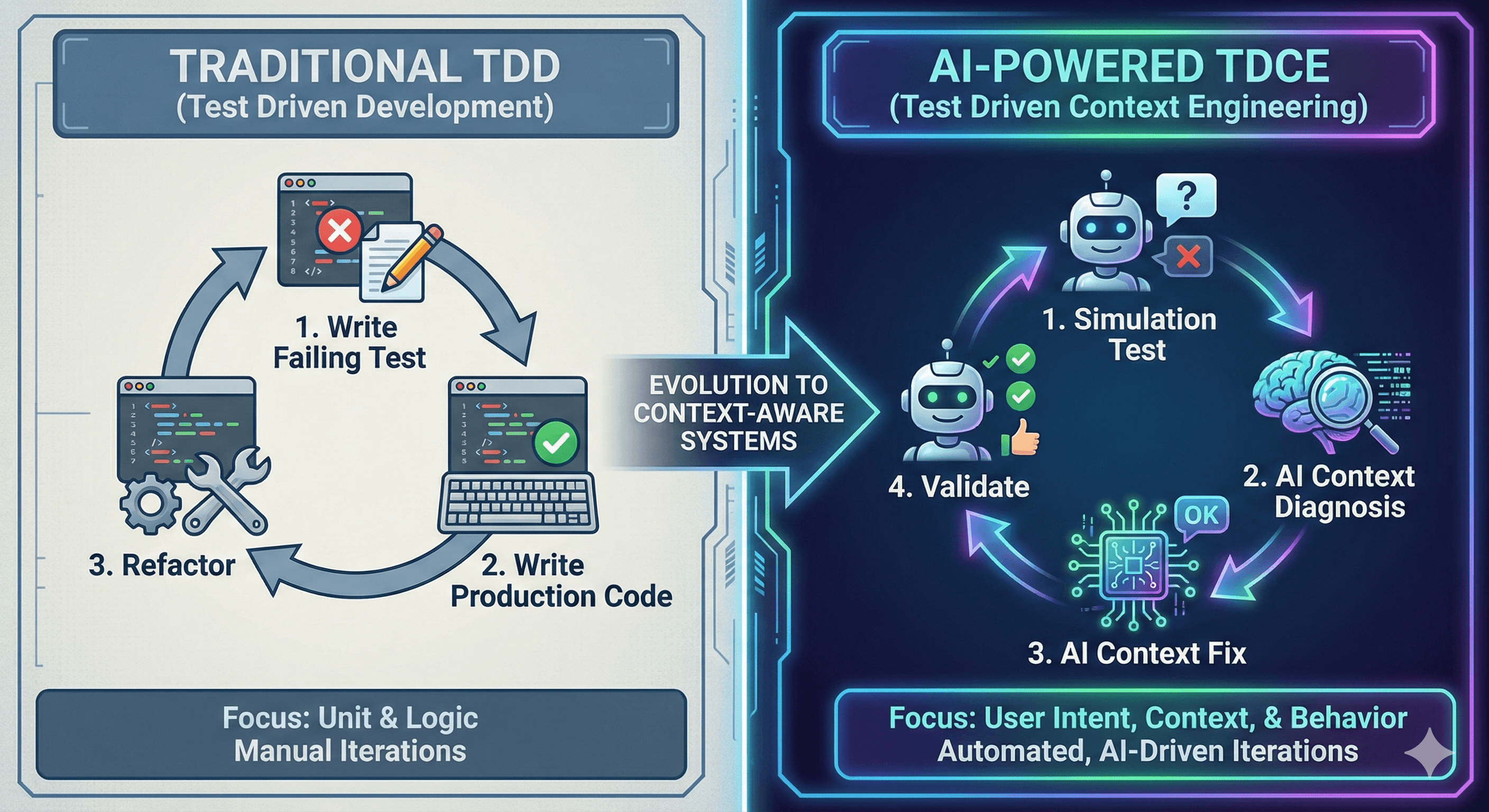
Just as TDD tamed the complexity of traditional software, TDCE applies the same rigor to the probabilistic world of LLMs. It moves us from 'writing prompts and hoping' to a structured cycle of verifiable improvement:
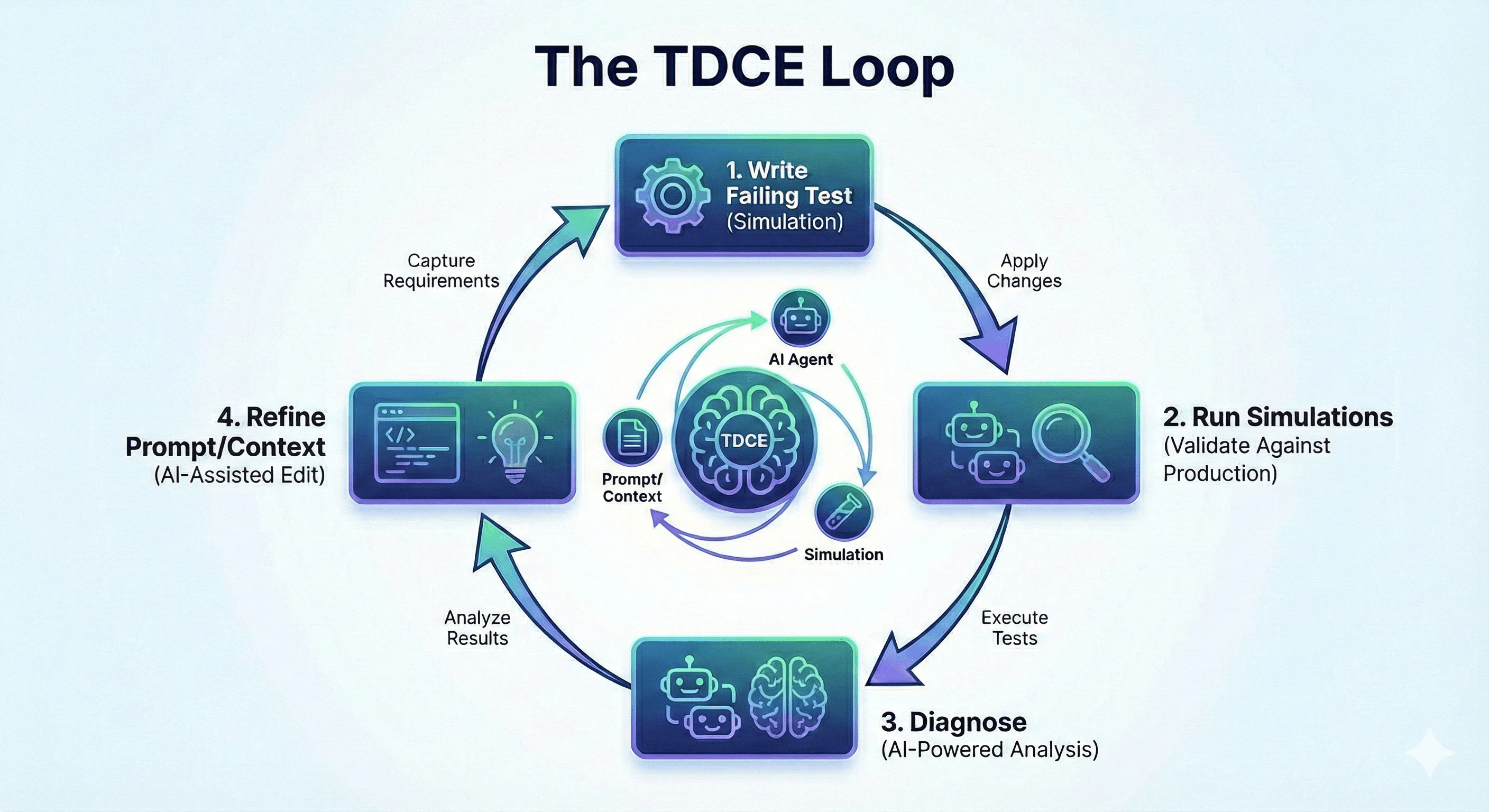
1. Capture requirements as simulation tests: Define concrete scenarios with measurable success criteria: "When a user from a company with fewer than 50 employees asks about pricing, the AI should offer educational resources and capture their email, but should NOT show the calendar booking widget."
2. Run simulations against current configuration: Execute automated conversations between simulated users (AI agents following scenario prompts) and your production AI agent. Simulations produce full conversation storylines, making behavior observable and debuggable.
3. Diagnose failures automatically: When tests fail, an Diagnostic Agent analyzes the conversation, the test definition, and the current configuration to determine root cause. The diagnostic agent provides specific, actionable recommendations.
4. Refine prompts and/or context: Apply the diagnostic recommendations to your prompt or knowledge base. An AI Copilot assists with this process, suggesting exact edits and explaining why they address the failure.
5. Validate improvements: Re-run the failed simulation to verify the fix works. If it fails, repeat steps (2) to (4). When it passes, then run the full simulation suite to ensure no regressions were introduced.
6. Build a regression suite: Each simulation becomes living documentation of expected behavior. Over time, accumulate comprehensive test suites that protect against future regressions and document the system's intended behavior better than any wiki or requirements doc could.
The power of the integrated loop
TDCE’s power doesn't come from any single clever technique; it comes from integration. Three systems work in concert: the Simulation Testing Engine provides the data, the Diagnostic Agent evaluates the conversation, the Copilot does root cause analysis and proposes fixes, and a Seamless Integration Loop between the three provides the speed.
Each component is valuable alone. But together, they create something greater: a feedback loop so tight and low-friction that it changes the fundamental nature of AI development. Testing becomes effortless, so teams test more. Diagnostics are automatic, so non-technical stakeholders become productive. Iteration is fast, so quality improves as a natural consequence of the workflow rather than a heroic effort by expert engineers.
The end of the vibe check era
We are moving toward a future where "it feels right" is no longer an acceptable standard for production AI. By adopting the principles of TDCE, organizations can finally stop fearing the "Regression Nightmare" and start building with the same confidence that revolutionized software twenty years ago. The era of the vibe check is over; the era of verifiable AI has begun.
We're hiring!
We’re always hiring curious, high-ownership people who want to build what’s next. If that’s you, check out the open roles on our careers page.

Michael PieperStaff Machine Learning Engineer, Spara
Sign up for the latest from Spara
Subscribe to get more GTM insights straight to your inbox.