
Go-to-market teams can agree on one thing: buyer intent matters. Where things break down is how intent gets defined, measured, and acted on.
For many organizations, intent still means a narrow set of surface-level signals. A form fill. A page visit. A generic lead score calculated from incomplete data. The result is familiar: sales teams chase activity instead of readiness, buyers receive generic follow-up, and marketing struggles to prove pipeline impact.
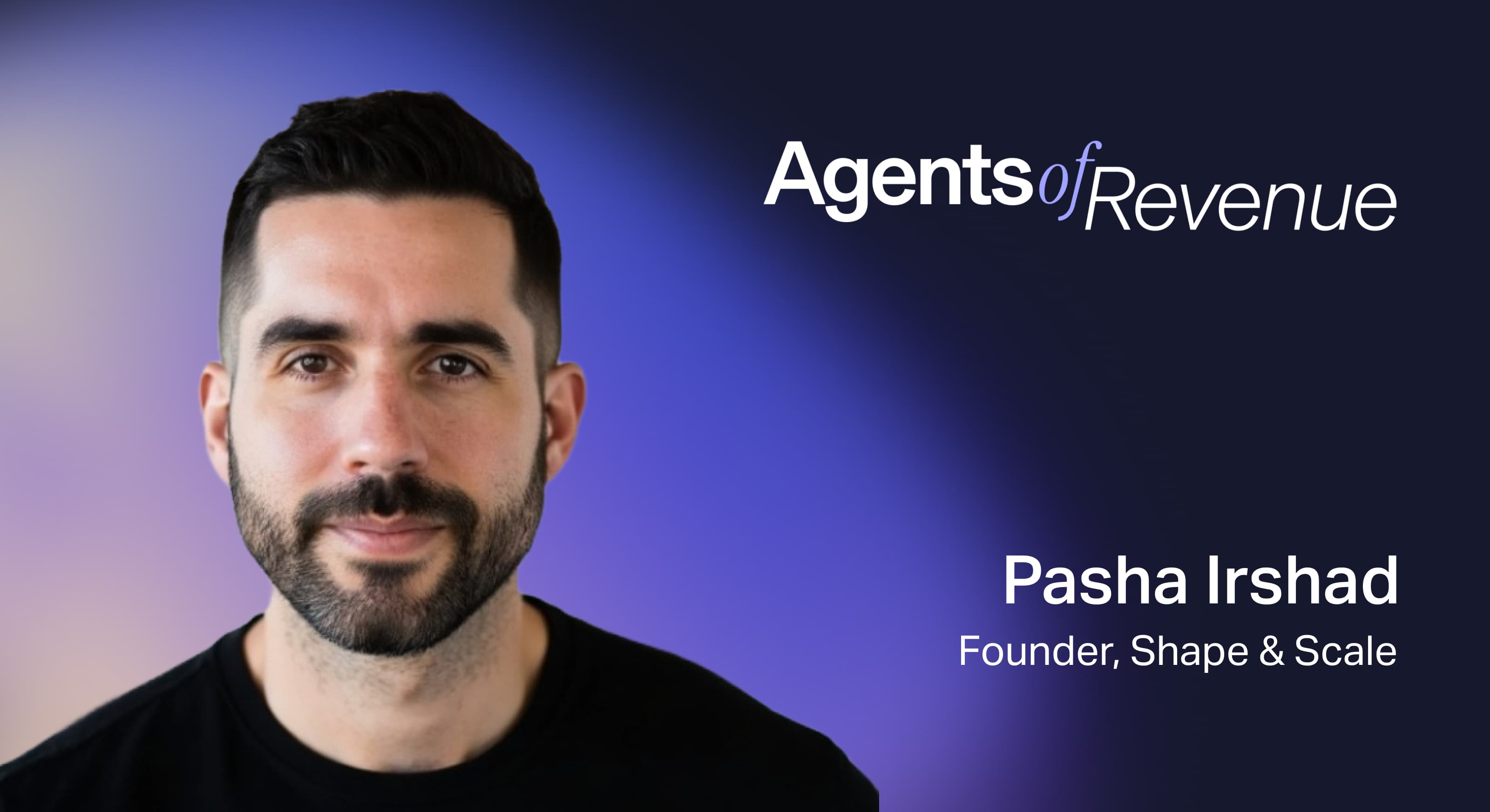
Pasha Irshad sees this challenge frequently in his work with go-to-market teams, particularly when buyer intent gets oversimplified.
Here’s how Pasha rethinks buyer qualification by acting on real intent and scaling that judgment with AI.
Buyer qualification breaks when intent gets oversimplified
One of the biggest mistakes Pasha sees teams make is treating intent as binary. Either someone is “in market” or they’re not. In practice, that oversimplification makes it harder to decide who to prioritize and how to engage.
What Pasha pushes teams to do instead is look for intent in layers. Website activity alone often does not provide enough signal, especially for early-stage companies or teams with lower inbound volume. When that is the only input, leads either get routed too quickly or sit untouched.
“When you go to real-world sources that align with different tiers of intent,” Pasha says, “you start to open the aperture of what’s possible.”
Those signals vary by company and market, but the pattern is consistent. Intent shows up as momentum, not single actions. That might include:
Indicators of organizational change or shifting priorities
Signals that suggest increased focus or investment
Hiring or leadership movement that points to timing
Engagement patterns that show sustained interest over time
Qualification improves when intent is treated as an input that shapes prioritization, routing, and engagement, rather than a simple yes-or-no decision.
That distinction is what makes contextual engagement possible. When teams understand what level of intent they are seeing, in addition to detailed information about the prospect, they can decide not just who to engage, but how and when to engage them.
In practice, this means combining firmographic basics with insight into what is happening inside the organization right now. Context turns intent signals into informed conversations instead of generic follow-up.
From the buyer’s perspective, relevance is the difference between helpful engagement and interruption. “If you understand the buyer better, your messaging becomes more contextually relevant,” says Pasha. “That improves the buyer experience immediately.”
Delivering that level of relevance consistently is no longer just a messaging challenge. It’s an infrastructure challenge. Context has to be gathered, interpreted, and applied during the interaction, not after a form submission or manual review.
This is why modern GTM teams are increasingly investing in systems that can recognize intent as it happens and respond with the right context immediately. Spara is built for this, using AI to engage and qualify buyers in real-time across chat, email, and voice, and orchestrating those interactions so sales steps in only when context and intent are clear.
How AI turns intent and context into scalable execution
Once teams understand how to identify real buying intent and apply context, the next challenge is scale. As inbound volume grows, manually sorting what is real versus what is not becomes a bottleneck.
“[AI gives you] the ability to qualify at scale,” Pasha says, “especially as you get larger.”
Otherwise, teams spend time manually disqualifying leads and rebuilding context from scratch. “That’s a huge time suck for a lot of my clients,” he explains.
AI can help by applying the same qualification logic consistently, using the data teams already own. That includes analyzing closed and ghosted deals across dimensions like company size, revenue, tech stack, vertical, and even the language buyers used to describe their pain.
“Using AI to sift through that data and build informed assumptions is pretty big,” Pasha says.
Once teams define different segments or playbooks, AI can help route accounts appropriately and support execution with the right guidance or messaging. Some signals point to targeted outreach. Others are better served by an off-the-shelf playbook or manual follow-up.
“I’ve seen teams do this by having account research served up without a rep really having to do anything,” Pasha says. “That’s where AI can really help.”
AI removes the manual disqualification burden, applies playbooks consistently, and gives sales and marketing a head start as volume increases.
Final takeaway
Pasha’s perspective reflects a broader shift across modern go-to-market teams. Speed-to-lead still matters, but speed without relevance is pointless. Relevance without speed is too late.
Winning teams do both. They recognize intent as it happens, understand what that intent actually signals, and respond in the moment. When intent, context, and assumptions are visible across the system, alignment follows naturally. Marketing no longer passes volume for sales to sift through. Sales trusts what shows up because the reasoning is clear.
This is where AI earns its place in GTM as an operating layer that applies shared logic at scale. Early engagement and qualification happen automatically, and sellers can prioritize high-intent buyers.
Spara brings this operating model together, orchestrating real-time engagement so intent is acted on immediately and buyers are met with relevance at every interaction.
Related posts
View all
GTM
How Matt Heinz aligns GTM teams to close more deals
Matt Heinz shares why sales and marketing alignment breaks when teams can’t move fast enough, and how real-time AI turns shared GTM strategy into action before buyers move on.
Mar 3, 2026
•
8 min read
GTM
What are the top AI sales assistant software tools in 2026?
Compare the best AI sales assistant software in 2026. Explore features, use cases, and how AI-native tools convert inbound demand into a qualified pipeline.
Mar 1, 2026
•
8 min read

GTM
Best conversational marketing software: A 2026 guide
Explore the best conversational marketing software in 2026. Learn how AI-native platforms improve engagement, qualification, and pipeline outcomes.
Mar 1, 2026
•
10 min read
Sign up for the latest from Spara
Subscribe to get more GTM insights straight to your inbox.