

Not long ago, chatbots were little more than glorified contact forms. They followed rigid scripts, asked basic qualifying questions, and funneled website visitors into inboxes or customer relationship management (CRM) systems for later follow-up. In an era defined by automation and rising expectations for customer experience, however, that model no longer works.
Buyers now expect real-time conversations and instant answers about pricing, integrations, and fit. They move fluidly across communication channels, including websites, messaging apps, and social media, always expecting interactions to feel relevant, informed, and continuous. This shift has redefined what a conversational marketing chatbot must do.
Modern conversational marketing chatbots have evolved into AI-driven, customer-centric agents that engage and convert buyers in real time. AI-native systems outperform retrofitted chatbots because they are built for dynamic, context-aware responses and are easier to set up and deploy.
Research from InsideSales shows that responding to inbound inquiries within the first five minutes can increase conversion rates by more than 8x compared to delayed follow-up. In a world where speed-to-lead defines competitive advantage, conversational marketing is now a core GTM capability, not a nice-to-have.
What is a conversational marketing chatbot?
A conversational marketing chatbot is an AI-powered system that engages website visitors through natural, two-way conversations designed to move buyers forward. Unlike traditional marketing automation or static forms, it supports meaningful customer interactions across the customer journey, from discovery to lead qualification to follow-up.
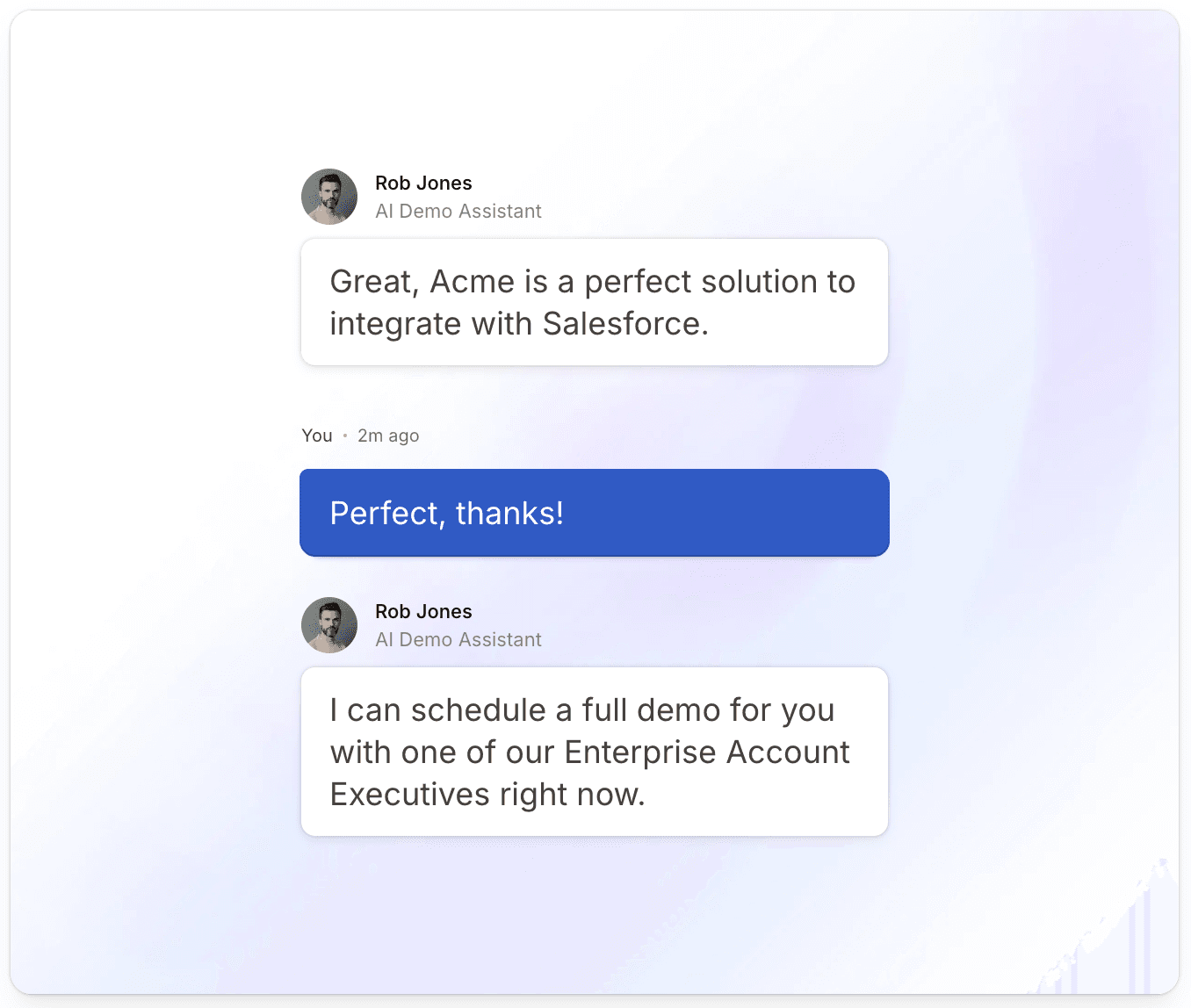
Earlier chatbots relied on keyword matching and rigid decision trees. When buyers went off script, the experience broke down. Real buyer conversations are nonlinear. Prospects ask follow-up questions, shift topics, and explore pricing, product recommendations, and integrations in a single session.
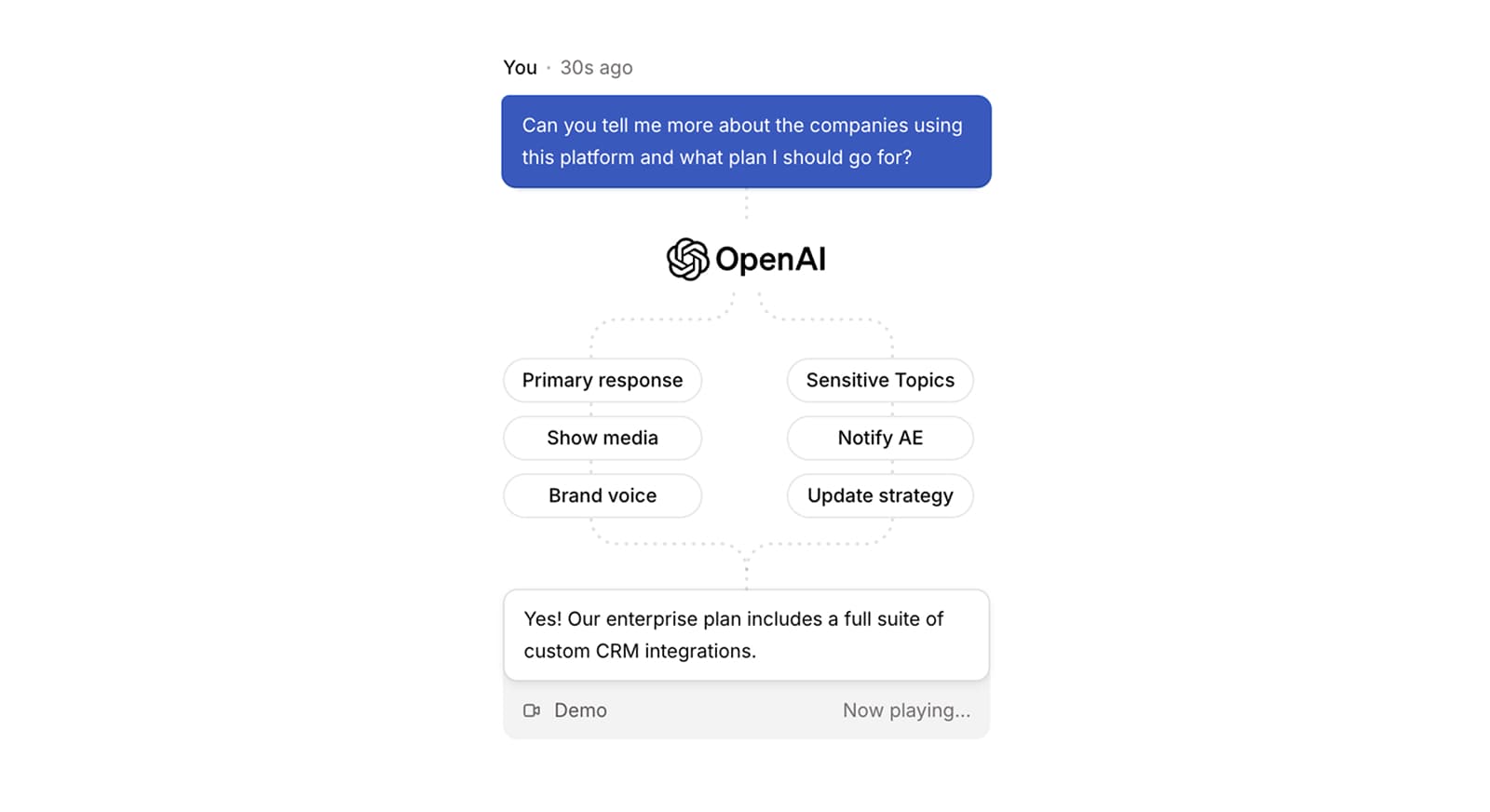
Modern conversational AI uses natural language processing (NLP) and machine learning to understand intent, retain context, and adapt responses dynamically. Instead of forcing predefined paths, AI-native agents respond based on what the buyer is trying to accomplish, enabling more meaningful conversations.
For GTM teams, this evolution removes friction. Conversations continue in real time, qualification logic adapts as intent emerges, and high-intent moments don’t get lost to forms or delayed email marketing follow-up. With strong context retention, AI-driven engagement stays accurate, relevant, and goal-oriented without forcing frustrated buyers to repeat themselves.
What do GTM teams expect from a chat-based engagement?
Modern marketing and sales leaders don’t evaluate conversational marketing tools in isolation. They evaluate them against real buyer behavior and revenue pressure. A chat experience is no longer judged by whether it responds, but by whether it moves the buyer forward without friction.
At a minimum, a conversational marketing chatbot must deliver more than automated replies. It needs to support live, high-intent interactions that feel continuous, accurate, and connected to the broader marketing efforts and sales team workflows.
GTM teams expect chat-based engagement to provide:
Instant answers to common and complex buyer questions, including pricing, integrations, and use cases
Accurate information grounded in real training data, not generic AI responses
Lead qualification that reflects actual sales criteria, not marketing-only scoring
Cross-channel continuity across chat, email marketing, and voice so buyers don’t have to repeat themselves
Clear handoff to the sales team when intent is high, with full context preserved
When these expectations aren’t met, the impact is immediate. Conversations stall. Buyers disengage. Customer satisfaction drops. When they are met, conversational engagement becomes a measurable driver of conversion rates, pipeline quality, and customer loyalty.
Core use cases for conversational marketing chatbots
Conversational marketing chatbots create value when they remove friction from the customer journey and accelerate high-intent engagement in moments that traditional marketing efforts and sales handoffs routinely miss. The strongest use cases show up where buyers want answers now and teams need signal instead of noise.
Turning website visitors into qualified conversations
Most website visitors never fill out forms, especially early in the buyer’s journey. Conversational marketing changes that dynamic by replacing static fields with real-time interactions. Buyers can ask questions, explore use cases, and get instant answers without committing to a demo request.
Because prospects self-select based on intent rather than compliance, this approach improves user experience, drives higher-quality lead generation, and creates more high-quality leads earlier in the funnel.
Automating initial qualification and routing in real time
AI chatbots can qualify leads using firmographic data, behavioral signals, and conversational context as the interaction unfolds. Instead of sending every inquiry to a sales rep, AI chatbots route only qualified leads, helping teams streamline operations. The result is faster response, cleaner pipelines, and more efficient sales cycles.
Capturing and accelerating high-intent moments
Buyers often ask pricing, integration, or timeline questions mid-session, when intent is highest. Traditional marketing funnels miss these moments or defer them to follow-up.
Conversational marketing chatbots capture them as they happen, enabling instant scheduling, targeted follow-up, or escalation to a live sales rep. This keeps momentum intact, prevents high-intent prospects from going cold, and improves retention.
Supporting sales through handoff-ready conversations
When AI systems pass conversations to human reps with full context, handoffs feel seamless. Notes, intent signals, and buyer needs transfer automatically, so sales teams don’t have to restart discovery or ask redundant questions. This improves sales team productivity, shortens time-to-value for buyers, and creates a more cohesive buyer experience across touchpoints.
Why AI-native systems outperform traditional chatbots
Rules-based chatbots struggle because they’re built on assumptions that no longer match buyer behavior. They assume conversations are linear, predictable, and contained within a single session or channel.
Real buyers don’t behave that way across modern communication channels. As volume and complexity increase, the cracks become obvious:
Scripted workflows break when buyers go off-path.
Slow or delayed follow-up reduces conversion potential.
Channel silos force buyers to repeat themselves.
Limited qualification logic creates low-quality pipeline.
AI-native systems solve these issues by design. Instead of forcing conversations into predefined paths, they adapt constantly. Context carries forward, qualification logic evolves as intent emerges, and engagement stays continuous, even as buyers shift questions, channels, or timing.
That design difference delivers measurable outcomes. Teams using Spara’s AI chat saw measurable impact within weeks. Fama increased qualified meetings by 2.5x and reduced demo no-shows by 40% in the first month of going live. Rho achieved a 3.1x lift in form-to-meeting conversion and booked 137 qualified meetings in a single quarter.
These results are the product of conversational marketing platforms built for real-time conversations, adaptive logic, and full-funnel engagement that aligns with how modern buyers actually operate.
What should you look for in a conversational marketing chatbot solution?
Choosing the right conversational marketing platform requires more than feature comparisons. GTM teams should evaluate systems based on how well they support accuracy, scalability, and buyer experience under real-world conditions.
AI-native architecture built after LLMs
AI-native platforms are designed around modern artificial intelligence models, not retrofitted onto legacy infrastructure. This enables stronger context retention, more reliable NLP, and built-in safeguards against hallucinations.
Spara’s AI is SOC 2-compliant and designed to detect inconsistencies in training data, ensuring responses stay accurate and grounded even in complex or high-stakes buyer conversations.
Multi-channel continuity across chat, email, and voice
Buyers don’t stay in one channel. Conversational marketing tools must support continuity across chat, email marketing, and voice to reflect how real buyer journeys unfold.
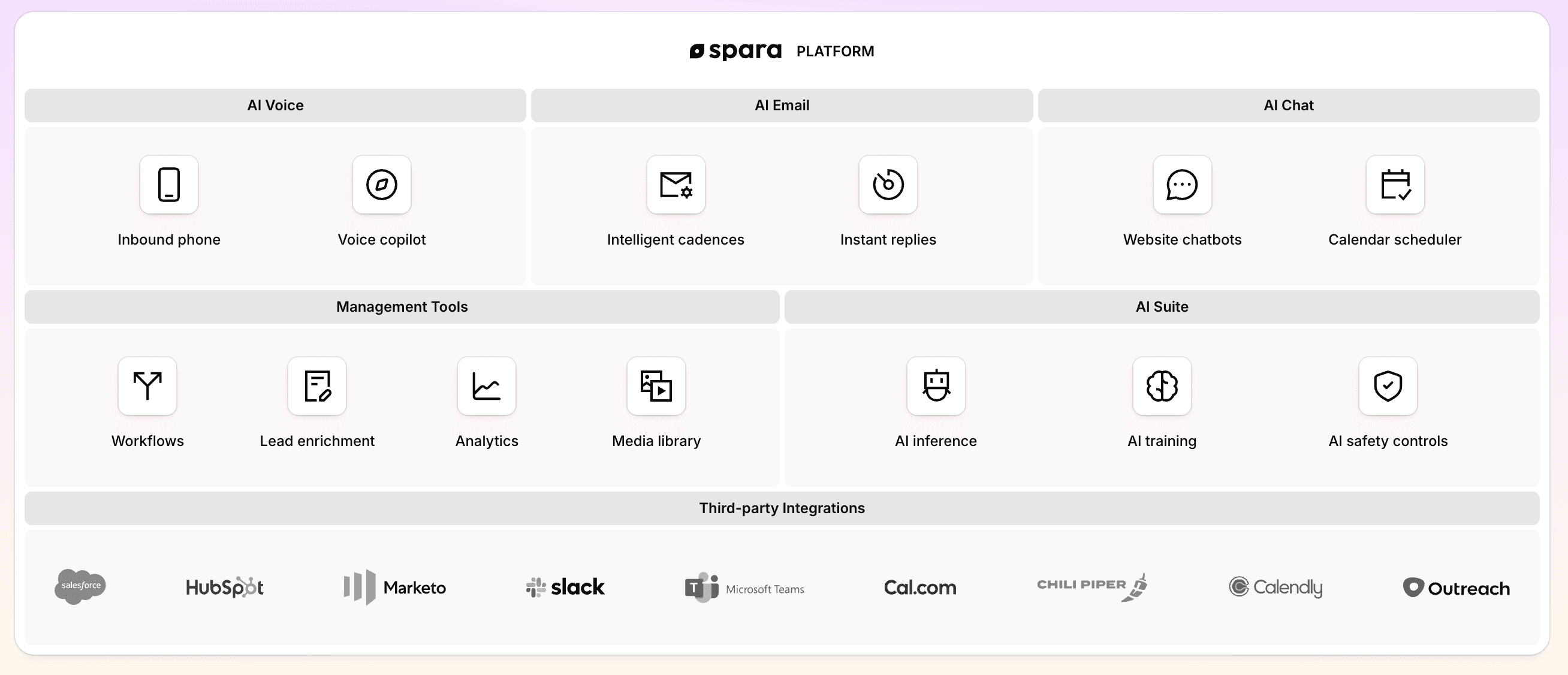
Spara’s AI chat, AI email, and AI voice agents share context across every interaction. Conversations pick up where they left off, improving retention, strengthening customer relationships, and creating a more cohesive buyer experience across touchpoints.
Seamless CRM integration and qualification flexibility
Static forms and rigid scoring models limit how well teams can respond to real buyer intent. Modern conversational marketing platforms should support dynamic qualification logic that adapts in real time and routes only quality leads into CRM systems.
Spara integrates directly with CRM and scheduling tools, passing handoff-ready conversations with intent signals and qualification notes intact. Sales reps jump in knowing exactly where the buyer is in the journey instead of starting discovery from scratch.
Fast implementation and low maintenance overhead
Many legacy platforms promise automation but require months of setup and ongoing rule maintenance to stay functional. That overhead slows teams down and erodes ROI.
Spara is designed to go live in days, not months. Because qualification logic and conversational flows adapt automatically, teams avoid constant rule rebuilding and manual upkeep, accelerating time-to-value without increasing operational load.
How Spara elevates conversational marketing beyond traditional chatbots
Spara approaches conversational marketing as revenue orchestration, not surface-level automation. Instead of optimizing isolated interactions, Spara coordinates conversations across channels to reflect how pipeline actually moves.

Spara’s AI chat engages website visitors through adaptive, goal-oriented conversations that qualify intent in real time. As buyer needs evolve, conversations can continue seamlessly through email or voice, with full context preserved across the platform so buyers never repeat themselves or reset the interaction.
Behind the scenes, Spara integrates directly into existing GTM stacks, automatically syncing meetings, qualification data, and intent signals into CRM and scheduling tools.
This orchestration is powered by an AI-native foundation designed for accuracy at scale, including hallucination detection and SOC 2 compliance, so teams can automate engagement without sacrificing governance or trust.
The result is faster pipeline acceleration, cleaner handoffs, and more consistent buyer experiences across every touchpoint.
Convert more inbound traffic with AI-native chat engagement
Conversational marketing chatbots have moved beyond lead capture. In 2026, the teams that win are the ones using AI-native systems to engage buyers in real time, qualify intent accurately, and convert conversations into pipeline.
Script-based bots can’t keep up with modern buyer behavior. AI-native agents can, because they’re built for adaptive conversations, continuous context, and high-intent moments that don’t wait for follow-up.
When chat, email, and voice work together as part of a single engagement system, more website conversations turn into qualified pipeline by design, not by chance. Watch Spara’s AI-native agents in action to learn more.

Lauren ThompsonHead of Marketing, Spara
FAQs
Related posts
View all
GTM
Corrina Owens on fixing what's broken in GTM
Corrina Owens shares how to streamline your GTM motion by fixing lead routing, simplifying buyer segmentation, focusing on high-impact signals, and embedding marketing in the deal cycle.
Feb 11, 2026
•
6 min read

GTM
Agentic marketing: boost inbound conversion with AI agents
Learn how agentic marketing uses AI agents to act on buyer intent in real time, improve conversion rates, and drive pipeline without adding headcount.
Feb 10, 2026
•
8 min read

GTM
How Taft Love drives higher lead conversion rates
Taft Love explains how to eliminate lead leakage and improve conversion rates by enforcing consistent sales behavior, building feedback loops between sales and marketing, and aligning incentives around revenue.
Feb 4, 2026
•
7 min read
Sign up for the latest from Spara
Subscribe to get more GTM insights straight to your inbox.