
By now, conversational AI isn’t a competitive advantage; it’s a baseline. Prospects expect instant answers when they land on your site, and they expect the same quality whether they're chatting at 3 p.m., emailing questions that evening, or calling your sales line the next morning.
That shift explains why the conversational platform category has evolved so dramatically. Drift pioneered conversational marketing by turning website chat into a lead generation channel. Qualified refined that approach for Salesforce-centric organizations, adding account-based marketing capabilities and deeper CRM integration.
Now, Spara is redefining the very same category with AI-native technology built specifically for revenue conversion: AI agents that qualify leads, answer questions, and book meetings across chat, email, and voice without manual intervention.
Unlike platforms that rolled out channels one by one, Spara's post-LLM architecture was designed to give revenue teams control over how they deploy AI agents across their entire GTM motion—whether that's inbound qualification, meeting scheduling, lead enrichment, or multi-channel engagement.
That architectural difference matters because revenue leaders—CROs, RevOps directors, marketers, and sales executives—are rethinking their entire Go-to-Market (GTM) stack. Legacy conversational platforms were built to capture contact information and pass leads to sales queues. Modern revenue teams need platforms that convert prospects during the initial conversation, update CRMs automatically, and route only qualified buyers to their reps.
This guide compares Spara and Qualified across AI performance, integration flexibility, implementation scalability, and return on investment. You'll see where each platform wins, which GTM strategies they fit best, and which architecture drives measurable pipeline growth instead of just collecting more leads.
Why sales leaders are re-evaluating Qualified in 2025
Qualified solved a real problem when it launched: Salesforce users needed better visibility into which accounts were visiting their website and a way to route high-value visitors to the right sales reps. The platform excelled at account-based marketing for companies running Salesforce-centric GTM motions.
But lead capture and routing stopped being enough. Revenue teams realized their conversational platforms were creating a new bottleneck: Prospects would chat with an agent, get qualified, then wait in a queue for a human SDR to follow up via email or schedule a meeting. The handoff gap between chat qualification and next steps was costing deals.
The business case for solving this with AI is clear: teams using artificial intelligence at least once a week report shorter deal cycles (78%), larger deal sizes (70%), and improved win rates (76%). Plus, 79% of frequent users say AI helped make their teams more profitable. Revenue leaders recognized that conversational platforms (or chatbots) needed to do more than capture leads. They needed to convert them.
Qualified's architecture reflects when it was built. The platform started as a chat tool and added channels sequentially: email came in 2024, voice in 2025. Each new channel required separate workflows and manual configuration. Multi-channel engagement meant managing three different systems that didn't share conversation context.
Compare that to how modern buyers actually engage:
The potential buyer chats on your website Tuesday afternoon asking about enterprise features.
Then, they email Wednesday morning with a pricing question.
Finally, on Thursday, they call because they need to talk through a specific integration requirement.
If each channel treats each interaction as a new conversation, your prospect repeats the same information three times—and your sales team looks disorganized and lead details can fall through the cracks.
The AI retrofit compounds the problem. Platforms built before large language models add AI features on top of decision-tree logic. The system can handle preset conversation flows, but breaks when prospects ask unexpected questions. Revenue teams report spending hours maintaining automation and routing rules to keep conversations on track.
Spara built its platform after LLMs matured. Now agents learn from your sales process, remember context across chat, email, and voice, and adapt their responses based on how each conversation develops. The architectural difference determines whether your conversational platform accelerates conversion or just collects more leads that still need manual follow-up.
This post-LLM approach means Spara agents aren't confined to preset workflows. Revenue teams configure agents for their specific GTM requirements—qualification criteria, routing logic, and engagement rules—rather than adapting their processes to fit rigid platform limitations.
Spara vs. Qualified: side-by-side comparison
Here's how Spara and Qualified compare on the criteria revenue leaders care about:
Spara | Qualified | |
AI approach | AI-native platform built around LLM architecture. Custom AI model trains on everything about your company (e.g., sales process, brand voice, and qualification criteria), using its entire website and documentation. SOC 2-compliant AI pipelines prevent hallucinations—agents flag inconsistent data instead of generating responses. | Originally launched as a chat platform in 2018. Added Piper AI SDR in April 2024. Custom LLM capabilities available for Enterprise customers as of 2025. Released 60+ features in 2024. |
Channels | Chat, email, and voice integrated from launch. Multi-channel architecture shares conversation context across all three touchpoints automatically. Supports multimodal responses including videos, PDFs, and slides. | Started as chat-native platform. Email capabilities added September 2024. Voice and video added August 2025. Each channel rolled out sequentially over seven years. |
Implementation | Fast implementation focused on time to value. No-code platform. | Official timeline: 30-60 days. Requires comprehensive planning with a dedicated implementation team. G2 reviews note the platform is "convoluted” and “somewhat difficult" to set up. |
Pricing model | Usage-based pricing. | Seat-based pricing tied to traffic levels and list sizes. Growth plan starts at $3,500/month. Premier and Enterprise plans require custom quotes. |
Security and compliance | SOC 2 + GDPR compliance built into core architecture. Enterprise-grade safety includes malicious and sensitive conversation flagging. AI agents flag inconsistent data instead of generating hallucinated responses. | SOC 2 Type II certified since 2020. Meets major privacy regulation requirements. Certification developed by AICPA measures security and availability. |
Conversion outcomes | Fama: 2.5x increase in qualified meetings, 40% reduction in demo no-shows, +32% SQL conversion lift, 28 hours per month of SDR work replaced. Rho: 3.1x increase in form-to-meeting conversion, 137 qualified meetings booked in Q2, 60% drop in SDR time per lead, output equivalent to 3 inbound SDRs. | Overall platform: $200M in generated pipeline as of January 2025, 9,000+ meetings booked, $6.8M in cost savings. Asana: 22% pipeline increase. Greenhouse: $27M in pipeline, 2,000 qualified meetings. 500+ companies using Piper AI SDR. |
Qualified delivers strong results for Salesforce-centric teams running account-based marketing programs. The platform's native Salesforce integration and account-based marketing (ABM) capabilities make the tool a natural fit for enterprise organizations with complex routing requirements and dedicated RevOps resources to manage implementation.
Spara takes a different approach: broader channel coverage from launch and architecture designed around how modern buyers move between chat, email, and voice. Revenue and marketing teams see measurable conversion improvements across their full inbound funnel, with case studies showing 2.5x to 3.1x increases in qualified meetings within the first month of deployment.
Spara vs. Qualified: where each platform wins (and loses)
Both platforms solve real problems for revenue teams. The question is which architecture fits your GTM strategy and where you're willing to compromise.
Where Qualified wins
Polished Salesforce ecosystem integration
Qualified was founded by former Salesforce executives Kraig Swensrud (former CMO) and Sean Whiteley (former Product SVP), and it was built natively on the Salesforce Platform. But the integration isn't bolted on; the platform traverses Salesforce's data model in real time.
And the depth shows in customer feedback. One G2 reviewer writes:
“The integrations are seamless, especially with Salesforce, ensuring we correctly route visitors, create leads, and book meetings. Our sales team loves being able to see, in real time, what visitors are doing on the site during live chats or before meetings. They also appreciate seeing when prospects arrive from Outreach sequences, which has been a huge win.”
Another customer explains the operational advantage:
“It allows me to keep tabs on who's visiting our site and chatting with our AI bot in the background while I actively manage other parts of my day. I can take over chats that our AI bot has already started, switch them over to my teammates if necessary. I can also sift through old data and signals to reach out to frequent visitors who may already be warmed up. Also love the ability to set meetings directly from the chat and even start a video chat right in Qualified. The data syncs right over to Salesforce, so I don't have to manually enter contacts, accounts, and opportunities. Our rep (Cormac) is super helpful too!”
Qualified ranks #1 on Salesforce AppExchange. Teams running Salesforce-first operations get native connectivity without middleware or custom API work.
Strong ABM motion for large enterprise accountsQualified integrates with ABM platforms like 6sense and Demandbase to surface account-based buying intent data. Sales teams see which target accounts are actively researching solutions vs. just which individuals filled out forms.
The ABM capability matters for enterprise sales cycles where multiple stakeholders research independently before coming together for evaluation. Connecting outbound sequences to inbound website behavior creates visibility that standalone chat tools can't provide.
According to Forrester's 2024 State of ABM research, ABM programs deliver 21-50% higher ROI than non-ABM marketing efforts, with 23% of organizations reporting ROI improvements of 51-200%.
Familiar brand and trusted by established SaaS organizationsQualified earned a 4.9/5 rating on G2 from over 1,200 verified reviews. The platform was named a Leader in G2's AI SDR Agent Software category and ranks as the #1 easiest-to-use AI SDR on G2.
Customer lists include Asana, Box, Brex, Clari, GE Healthcare, Greenhouse, Crunchbase, and Plaid—companies that run extensive vendor evaluations before committing to GTM infrastructure. Established vendors with seven-year track records and recognizable customer logos make procurement conversations simpler than explaining newer entrants.
Where Qualified loses
Limited flexibility beyond Salesforce environmentsQualified's strength—deep Salesforce integration—becomes a constraint for teams using HubSpot, Marketo, or other CRM systems as their primary revenue engine. One G2 reviewer explained the integration challenge:
“The Zoominfo integration requires a specific (and pricey) enterprise API package, which feels a bit limiting since Zoominfo data quality is stronger than Clearbit’s in our experience. Also, while the Marketo integration is functional, it's not fully built out — specifically, AI email follow-up tied to form fills doesn’t fire instantly. That said, our CSM helped us build a Salesforce-based workaround that solved the issue. Lastly, while I appreciate how often they roll out new features, some feel a bit rushed and not fully productized — though the pace of innovation is still impressive.”
The reviewer's experience highlights a pattern: workarounds function but require dedicated admin resources and custom configuration to handle scenarios that multi-CRM platforms support natively.
Another customer mentioned configuration complexity:
“While the platform is robust, we’ve encountered a few limitations. First, we’d love more branding flexibility in email campaigns—being able to fully align these experiences with our brand would make them far more usable for us.
We also ran into some configuration challenges integrating button experiences with our CMS, which created friction early on. That said, Michael Witt has been outstanding—he worked closely with our web team and navigated complex internal requirements from both Marketing and Legal/Compliance to get us to a fully functional, compliant solution. His partnership made all the difference.”
Salesforce-centric architecture works well for Salesforce-first companies. Teams running other systems find themselves building custom solutions for functionality other platforms include out of the box.
Sequential channel rollout limits multi-channel fluidityQualified launched as a chat platform in 2018. Email capabilities were added six years after launch. Then, voice and video arrived seven years after the platform shipped.
Sequential channel expansion means each new communication method requires separate development, integration, and workflow configuration. So, chat agents don't automatically share context with email agents because the channels were built independently.
Contrast this with platforms designed for multi-channel engagement from the start, where conversation context flows automatically across chat, email, and voice without manual integration work.
AI capabilities require ongoing training and playbook maintenanceQualified added Piper AI SDR in April 2024, six years after the core platform launched. The AI features work, but customers note limitations in how agents handle nuanced questions.
One G2 reviewer wrote:
“I do wish our AI SDR could be better equipped in answering more specific questions our prospects may ask. Perhaps we need to do a better job at teaching it how to address such inquiries. It would also be nice if we could display and play video in our offers.”
The challenge reflects how retrofitted AI differs from platforms designed around LLM architecture from launch. Qualified agents handle preset conversation flows effectively but struggle when prospects ask questions outside programmed scenarios. Teams spend time maintaining playbooks and training the AI on edge cases that adaptive systems learn through simple conversation.
Complex implementation and seat-based pricingQualified's official implementation timeline runs 30-60 days and requires comprehensive planning with a dedicated implementation team. G2 reviews describe the setup process as "convoluted and somewhat difficult."
Much of that complexity comes from Qualified's breadth. The platform handles sophisticated routing logic, ABM integration, custom workflows, and multi-team permissions. Enterprises with dedicated RevOps teams navigate this well. But, leaner organizations without full-time Salesforce admins find the learning curve steeper.
Qualified’s depth, in turn, carries over into its commercial model. It uses seat-based pricing with custom quotes based on team size and usage volume. Pricing details require contacting its sales team for a customized plan.
Seat-based models, however, introduce challenges as companies scale. As your sales team expands or website traffic increases, costs climb even if conversion rates stay flat. Sales leaders who want to add reps need to justify incremental seat costs rather than tying investment directly to pipeline outcomes.
Where Spara wins
Built post-LLM with natively adaptive AI across chat, email, and voice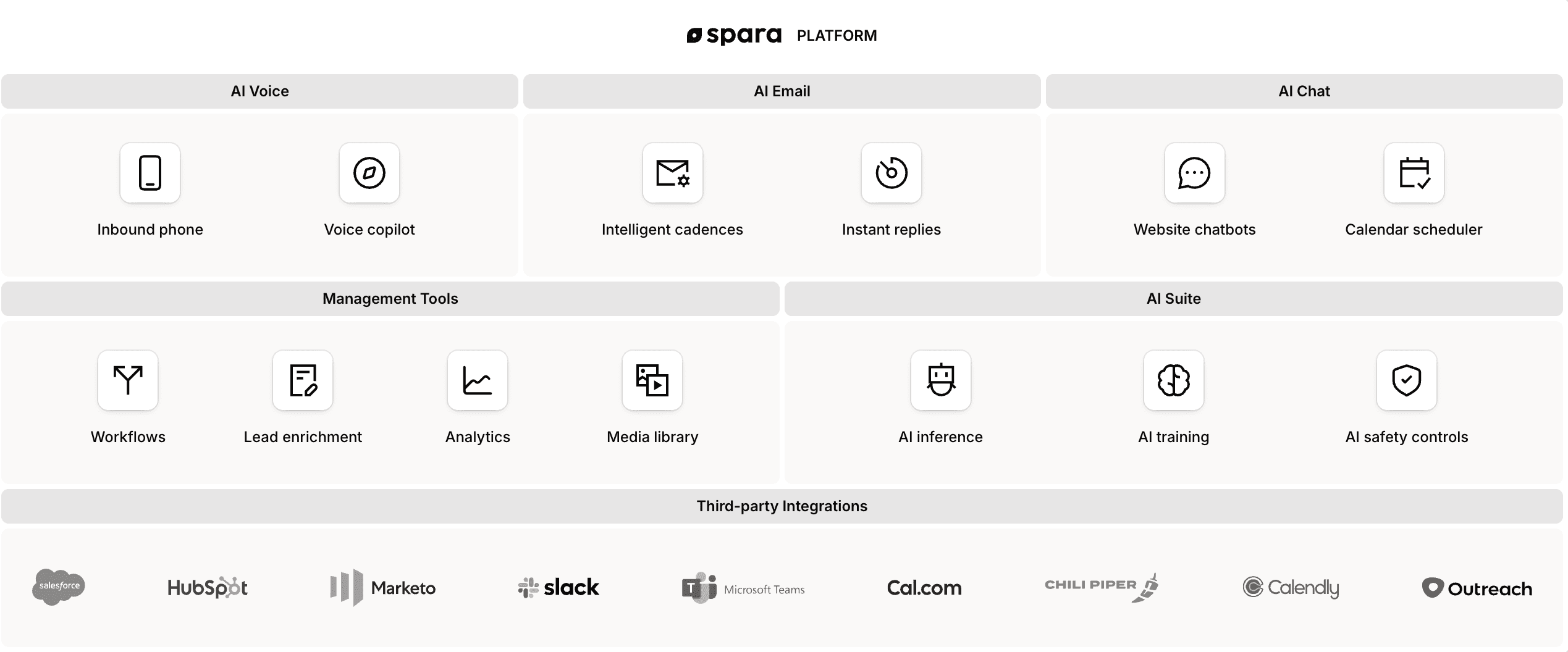
Spara designed its entire AI platform around how large language models process conversations, remember context, and generate responses. Its post-LLM architecture delivers two critical advantages: agents adapt to any conversation flow without breaking, and revenue teams control exactly how agents operate across their GTM motion.
This means you're not waiting for the vendor to add your required channel or feature. You define qualification criteria, routing logic, and engagement rules that match your business requirements. Agents execute those rules across chat, email, and voice automatically.
Custom AI models train on your company's sales process, brand voice, and qualification criteria. Native integrations with Notion, Google Drive, SharePoint, and Confluence let you upload product documentation and sales collateral to train agents. Agents also learn from past successful conversations. The system improves conversion quality over time without manual playbook maintenance.
Multi-channel intelligence was built into the platform from launch, not added down the line. When prospects chat Tuesday, email Wednesday, and call Thursday, Spara agents maintain conversation context across all three channels. Prospects don't repeat information, and your sales team sees complete interaction history regardless of which channel the prospect used.
Delivers measurable pipeline impact with proof pointsSpara customers report conversion improvements within the first month of deployment.
Fama's results after one month:
2.5x increase in qualified meetings booked
40% reduction in demo no-shows
+32% SQL conversion lift across all inbound leads
28 hours of manual SDR work replaced monthly
CEO Ben Mones said: "Spara has dramatically increased our most important inbound conversion metric. In all my years of GTM experience, I've never seen a product have such an impact so quickly. The impact is simple: we will close more revenue because of Spara."
Rho saw similar results in its first month:
3.1x increase in form-to-meeting conversion
137 qualified meetings booked in Q2 alone
60% drop in SDR time spent per lead
Output equivalent to 3 inbound SDRs
CRO Tommy McNulty explained: "Spara helped us scale during a period of immense demand. Now our reps only engage when it counts. And every lead gets a guided, high-conversion experience."
The proof points focus on conversion rate improvements and efficiency gains—metrics that directly impact pipeline—rather than vanity measures like total pipeline generated that don't account for baseline growth.
SOC 2 + GDPR compliance built into core architectureSpara designed compliance into the platform foundation rather than adding certifications after launch. SOC 2 and GDPR requirements shaped how the system handles data, processes conversations, and flags sensitive information from the beginning.
Enterprise-grade safety includes malicious and sensitive conversation detection. Agents flag inconsistent data instead of generating hallucinated responses, which is critical for industries where inaccurate product information creates liability.
Compliance as architecture rather than bolt-on certification reduces enterprise security review timelines. This way, infoSec teams audit the platform design instead of evaluating how well added features meet requirements.
Fast time to value without extended implementationsSpara's no-code platform delivers results without dedicated technical resources or month-long implementation projects. The platform went live for Rho "in days, not quarters," according to its case study.
The speed advantage compounds for teams that need to demonstrate ROI quickly and optimize their conversion funnel. Revenue leaders facing pressure to justify AI investments get measurable results within weeks.
Fast deployment also means less organizational disruption. Sales teams don't spend months adjusting workflows or waiting for integrations to go live—they see qualified meetings appear on calendars while still running existing processes in parallel. And because the platform is built for self-service configuration, you can continue optimizing agent behavior over time without vendor support tickets or professional services engagements.
Usage-based pricing eliminates headcount taxSpara uses usage-based pricing that scales with conversation volume rather than team size. You pay for the work agents perform (qualifying leads, answering questions, booking meetings) instead of for seats or user licenses.
This model removes the growth penalty that seat-based pricing creates. As your sales team expands or website traffic increases, costs scale with engagement rather than climbing automatically because you added headcount.
Usage-based pricing also aligns vendor incentives with customer outcomes. Spara succeeds when your agents handle more conversations that convert to pipeline growth.
Where Spara loses
Smaller brand recognition than QualifiedSpara launched recently with $15 million in seed funding. The company has fewer customer logos, less coverage, and smaller community presence than Qualified's seven-year-old brand.
Brand recognition affects procurement processes. Qualified's name recognition and established customer base make internal approvals simpler for risk-averse enterprises. Spara requires more explanation and validation during vendor evaluation.
The gap narrows as Spara builds case studies and customer references, but early-stage vendors carry perceived risk that established platforms don't.
Newer to market with faster iteration cyclesWhile Spara launched fewer third-party integrations than Qualified, it boasts a particular advantage over its competition.
Spara ships new capabilities in weeks, not quarters. Plus, when you consider its implementation of AI, the platform launched with integrated chat, email, and voice—breadth that took legacy competitors seven years to build sequentially.
Modern architecture without legacy constraints means when your GTM strategy shifts or markets demand new capabilities, you're not waiting for vendor roadmap cycles designed for slower eras.
Early customers report feature requests becoming production capabilities within release cycles that would require legacy vendors multiple quarters to execute. The trade-off: fewer edge cases tested at enterprise scale, though those get addressed at modern velocity as the customer base grows.
The strategic choice
Qualified was built for a Salesforce world where chat captured leads and ABM platforms identified target accounts. The platform excels at those workflows.
Spara was built for a multi-channel, AI-native world where prospects move fluidly between chat, email, and voice, and where agents qualify, convert, and route without human intervention. Revenue teams choosing between these platforms are choosing which architecture matches how their buyers engage and how their sales teams operate today (and tomorrow).
The post-LLM shift: what "AI native" really means
Revenue leaders see "AI-powered" on every conversational platform. The label hides an architectural difference that determines whether your system adapts to buyer questions or breaks when conversations go off-script.
AI-assisted platforms started as rule-based chat tools and added GPT-style responses later. The core system still runs on decision trees—if the prospect says X, the system responds with Y. When buyers ask questions outside programmed scenarios, the conversation escalates to human reps.
AI-native platforms built their entire architecture around how large language models process context and generate adaptive responses. Agents learn from your sales process and adjust qualification approaches based on how each conversation develops.
The difference shows up in four ways that affect pipeline:
Accuracy: Spara uses SOC 2-compliant AI pipelines with guardrails that prevent hallucinations. Agents flag inconsistent data instead of generating responses, which matters for regulated industries where inaccurate product claims create liability.
Personalization: Native integrations with Notion, Google Drive, SharePoint, and Confluence let you upload sales collateral and product documentation to train agents. Agents also learn from your website, CRM data, and past conversations. Conversational quality improves over time without manual playbook updates.
Scale: Platforms designed around LLM architecture handle chat, email, and voice through the same underlying system. Context flows automatically between channels without rebuilding workflows for each one.
Speed: AI response latency under 10 seconds captures intent while prospects are actively evaluating. Delays beyond that increase bounce rates as buyers move to competitors who respond faster.
Flexibility: Post-LLM platforms give revenue teams control over how agents operate across their entire GTM motion. You configure agents for your qualification logic, routing rules, and engagement strategy—rather than adapting your processes to fit preset platform workflows. When your business requirements change, you adjust agent behavior through configuration instead of requesting vendor feature builds.
Choosing conversational platforms comes down to two questions: Was this system built after LLMs matured, and does it give you control over how AI agents operate across your entire GTM motion?
Post-LLM architecture isn't just about better AI safety or context retention—though Spara delivers both through SOC 2-compliant pipelines and cross-channel memory. The fundamental difference is platform philosophy.
Legacy platforms started with a single channel (chat) and added features sequentially as customer demand emerged. Teams adapt their GTM processes to fit what the platform offers.
Post-LLM platforms like Spara flip that model. You deploy agents for whatever use cases your business requires—inbound qualification, meeting scheduling, lead enrichment, nurture sequences, or multi-channel engagement. The platform adapts to your GTM strategy, not the other way around. When your requirements change, you reconfigure agent behavior instead of waiting for vendor roadmap updates.
This matters because no two GTM motions are identical. Your qualification criteria, routing logic, and engagement rules reflect your specific market, product, and sales cycle. Platforms built around preset workflows force compromises that leak pipeline. Platforms built for configurability let you execute your strategy exactly as designed.
Final verdict: Spara vs. Qualified in 2025
Qualified delivers strong results for Salesforce-centric organizations running account-based marketing programs. The platform's native Salesforce integration and ABM capabilities make it a natural fit for enterprise teams with dedicated RevOps resources. However, the sequential rollout of email and voice means teams manage channels separately rather than through unified conversation flows.
Spara built its platform around how prospects engage in 2025, moving fluidly between chat, email, and voice with agents that remember context across all three channels. Revenue teams see 2.5x to 3.1x conversion improvements within the first month, instead of after optimizing for several quarters.
For revenue leaders prioritizing measurable ROI, faster pipeline velocity, and a flexible AI platform that adapts to their specific GTM requirements rather than forcing teams into preset workflows, Spara wins.
Ready to see the difference AI-native architecture makes for your inbound conversion? Chat with Spara and experience how multi-channel agents qualify, convert, and route prospects in real time.
FAQs
Related posts
View all
GTM
AI SDRs: The future of sales development
Traditional SDR models can't scale. AI SDRs automate qualification and routing to convert 3x more inbound traffic without adding headcount.
Feb 24, 2026
•
10 min read

GTM
How Kathleen Booth is solving the buyer intent decay problem
Kathleen Booth explains why intent data fails when teams can't act fast enough, and how real-time AI closes the gap before buyers move on.
Feb 19, 2026
•
6 min read
GTM
Corrina Owens on fixing what's broken in GTM
Corrina Owens shares how to streamline your GTM motion by fixing lead routing, simplifying buyer segmentation, focusing on high-impact signals, and embedding marketing in the deal cycle.
Feb 11, 2026
•
6 min read
Sign up for the latest from Spara
Subscribe to get more GTM insights straight to your inbox.